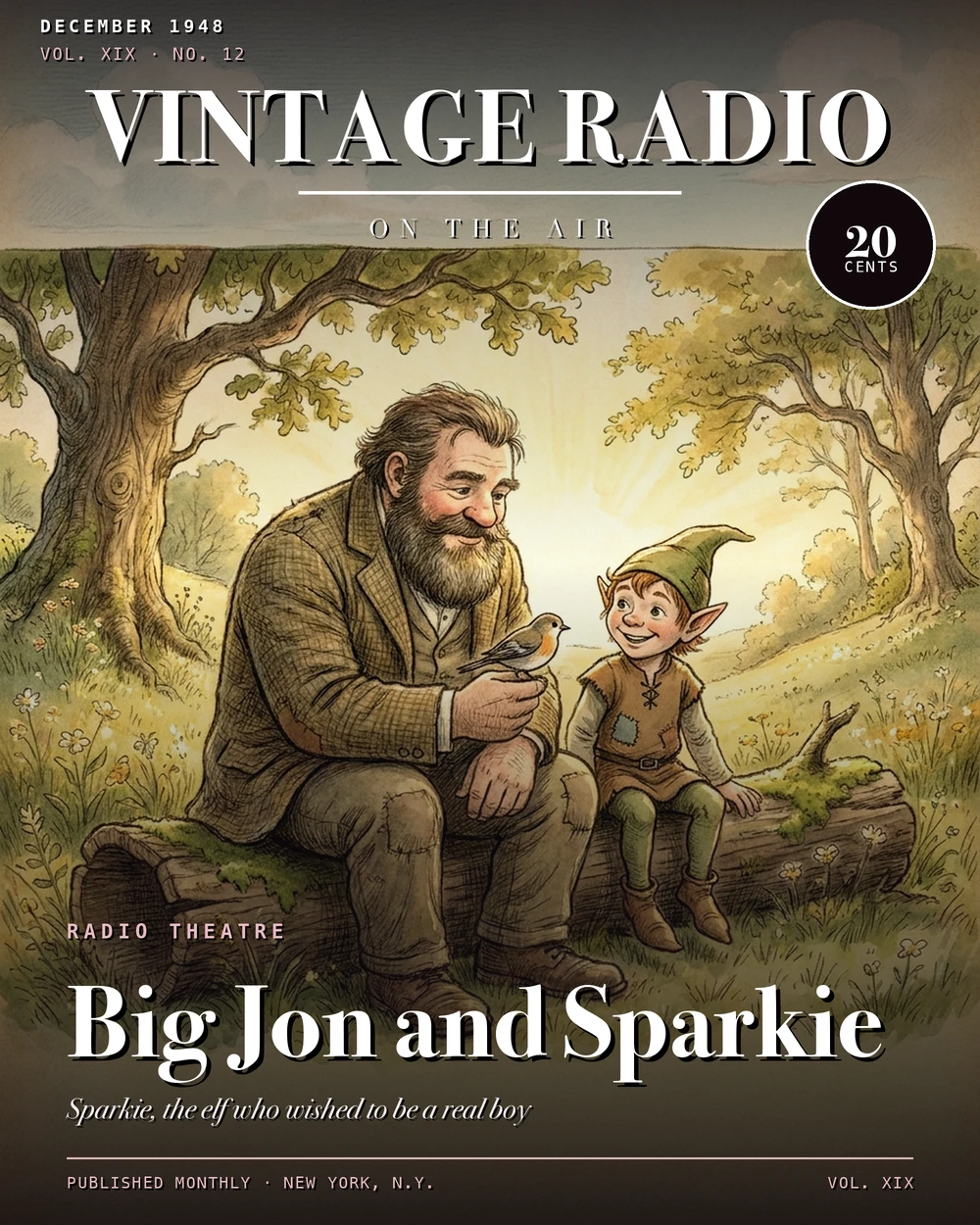
Big Jon and Sparkie
The Elf Who Wanted to Be a Real Boy
The premise sounds almost like a fairy tale itself: a little elf from the land of make-believe, who wants more than anything else in the world to be a real boy, befriends a regular adult named Big Jon and together they have adventures, tell stories, and sing songs for children listening at home. What made it work was Jon Arthur — one man playing every fantasy character on the show while also serving as its creator, producer, and anchor. From its ABC debut on February 1, 1950, the show leaned entirely on Arthur's ability to become whoever the story needed, from a comic cab driver to a pompous mayor to the elf at the center of it all.
Arthur's path to the show ran through a Pennsylvania Lutheran parsonage, a radio announcing course, and a 1939 start at a West Virginia station. His real breakthrough came when a scheduled act failed to arrive for a broadcast and he improvised a version of The Three Little Pigs, playing directly to two children he could see in the studio observation booth. The instinct to speak directly to a child audience — not at children, but to them — stayed with him. By around 1947, working at WSAI in Cincinnati, he had developed both Sparkie and an early version of the Saturday show. When ABC picked up the concept, he expanded it into two separate programs.
Two Shows, One Man
The weekday program, Big Jon and Sparkie, ran five days a week at 5 PM in a 30-minute format, later trimmed to 15 minutes beginning in 1951. The Saturday companion, No School Today, launched February 18, 1950, aired at 9 AM, and ran a full 120 minutes before being shortened to 90 minutes the following year. Both used co-op advertising, which let local stations sell spots to regional sponsors — a setup that gave the shows flexibility and local roots. Cincinnati listeners, for instance, heard ads for Reubell's Rye Bread and Barq's Root Beer.
The daily show carried on 181 ABC stations; No School Today reached 275 stations and reportedly drew around 12 million weekly listeners. The two programs were billed as "for the younger generation and the young at heart," a framing that was honest about who was actually in the room. Parents and older siblings were listening alongside the kids, and the show made room for them without losing the children.
No School Today had a distinct rhythm. It featured a marching segment with "Gil Houlihan and his Leprechaun Marching Band," during which listeners were encouraged to march around their breakfast table. There was a birthday segment where children who wrote in would be mentioned on air, with a song called "Happy Birthday, Friend." Sparkie would recount the latest installment of a movie serial called Captain Jupiter, which he and his friend Rabbit Ears McKester had seen at the movies — complete with recurring villains Montmorency Clutchrider and Ivan Crusingspeed. There were also "Little Orley" segments, recorded stories written and voiced by Hugh "Lumpy" Brannum — the same performer who later became Mr. Green Jeans on Captain Kangaroo. The Little Orley pieces had originally been created for a Fred Waring radio program that never aired; when that project fell apart, the recordings found a home on No School Today instead.
How It Was Made
Arthur achieved Sparkie's distinctive high-pitched voice through trick recordings — recording his own voice and playing it back at increased speed. He was doing this years before Dave Seville used the same technique for Alvin and the Chipmunks in 1958. For the first two years of the show, Sparkie had no visual depiction at all; he was purely a voice. When Arthur decided to give the character a face, he turned to Leon Jason, a comic book artist, and asked him to create a composite image based on letters from listeners describing what they thought Sparkie looked like. In only two appeals asking listeners to write in, Arthur received 25,000 pieces of mail.
The scripts came primarily from Don Kortekamp, an editor at WSAI who had known Arthur since the Cincinnati days. Kortekamp drew on his childhood in Cheviot, Ohio to build out the recurring cast: Mayor Plumpfront, the Krausers, Clyde Pillroller, and Eukey Butcha were all based on people he actually knew growing up. He worked at WSAI alongside Rod Serling and Jean Shepherd before either became famous. Arthur himself said that everything on the show was taken from life — the stories came from his own children's experiences or from letters listeners sent in. His three-year-old daughter Debbie even played "the little girl next door" on the show.
By 1956, Arthur had reportedly played around 200 roles across the run. The characters included Ukey Betcha, a comic cab driver; Mayor Plumpfront of Cincinnati; and Daffodil Dilly, a "fabulously wealthy Florida widow" who became engaged to Mayor Plumpfront and was kidnapped close to her wedding. Sparkie also owned a Boston Bulldog named Bunny, whose misadventures generated at least one arc titled "The Canine Mutiny." Fan accounts mention storylines that reached into space, including something called "The Purple Gooey Globular." One of the show's more unusual moments was a skit about two rabbits — one black, one white — told as a parable on race relations.
Arthur also pretended to have a set of "magic spyglasses" that let him see into listeners' homes and check up on their hygiene. It sounds like a simple gimmick, but it was a piece of participatory fiction — the kind of direct relationship with the audience that gave the show much of its warmth.
Beyond the Studio
The show had a real-world presence outside the radio. A local Cincinnati businessman named Donald Poynter, who worked in the novelty business, produced a physical Sparkie puppet for merchandise and live stage appearances. The stage version was a large string puppet about 36 inches tall, dressed in scarlet red overalls and a jet black shirt with brown carved hair. Arthur took the character on tour with live performances using this puppet.
The show also crossed into print. Ziff-Davis published a comic book series — initially titled Big Jon and Sparkie, later renamed Sparkie, Radio Pixie — that ran four issues, with issues three and four appearing in August and October of 1952. Art and stories came from Ruth Ruhman and the Jason Comic Art studio, the same outfit run by Leon Jason who had designed Sparkie's look. Editor Alden Getz also put out The Daily Weekly, a promotional newspaper giveaway tied to No School Today. The show even made a brief appearance in Mad magazine: Harvey Kurtzman wrote "Big John" and "Sparkie" into his "Robin Hood!" parody in Mad issue #4 from June 1953, illustrated by John Severin — an early sign that the characters had enough cultural presence to be worth sending up.
The show aired on WCPO television in Cincinnati during the 1950s, though it never made a successful national transition to television.
After the Network Run
WSAI did not renew its contract with Arthur in 1951, and the show moved to new Cincinnati studios to continue its ABC broadcasts through 1954 for the daily show and 1958 for No School Today. After the network run ended, Arthur continued broadcasting on shortwave radio for a period and later hosted a midday program at WKRC in Cincinnati during the 1960s. Beginning around 1962 and running for roughly 20 years until Arthur's death in February 1982, the show found a second life on the Family Radio Network, reaching an entirely new generation of children who had no memory of the original ABC broadcasts.
Jon Arthur — born Jonathan Arthur Goerss on June 14, 1918, in New Kensington, Pennsylvania, the son of a Lutheran minister — died in Alameda County, California, at age 63. KGO radio in San Francisco broadcast a tribute to him after his death, and his life story was later featured on Unshackled, a Christian radio program out of Chicago. He had married a woman from West Virginia, whom he met during his early radio career in Beckley. The theme song that opened every broadcast was "The Teddy Bears' Picnic," performed in its lyrical version by a vocalist named Ann Stephens — a piece of music that, for anyone who grew up with the show, would have carried the whole world of it.